
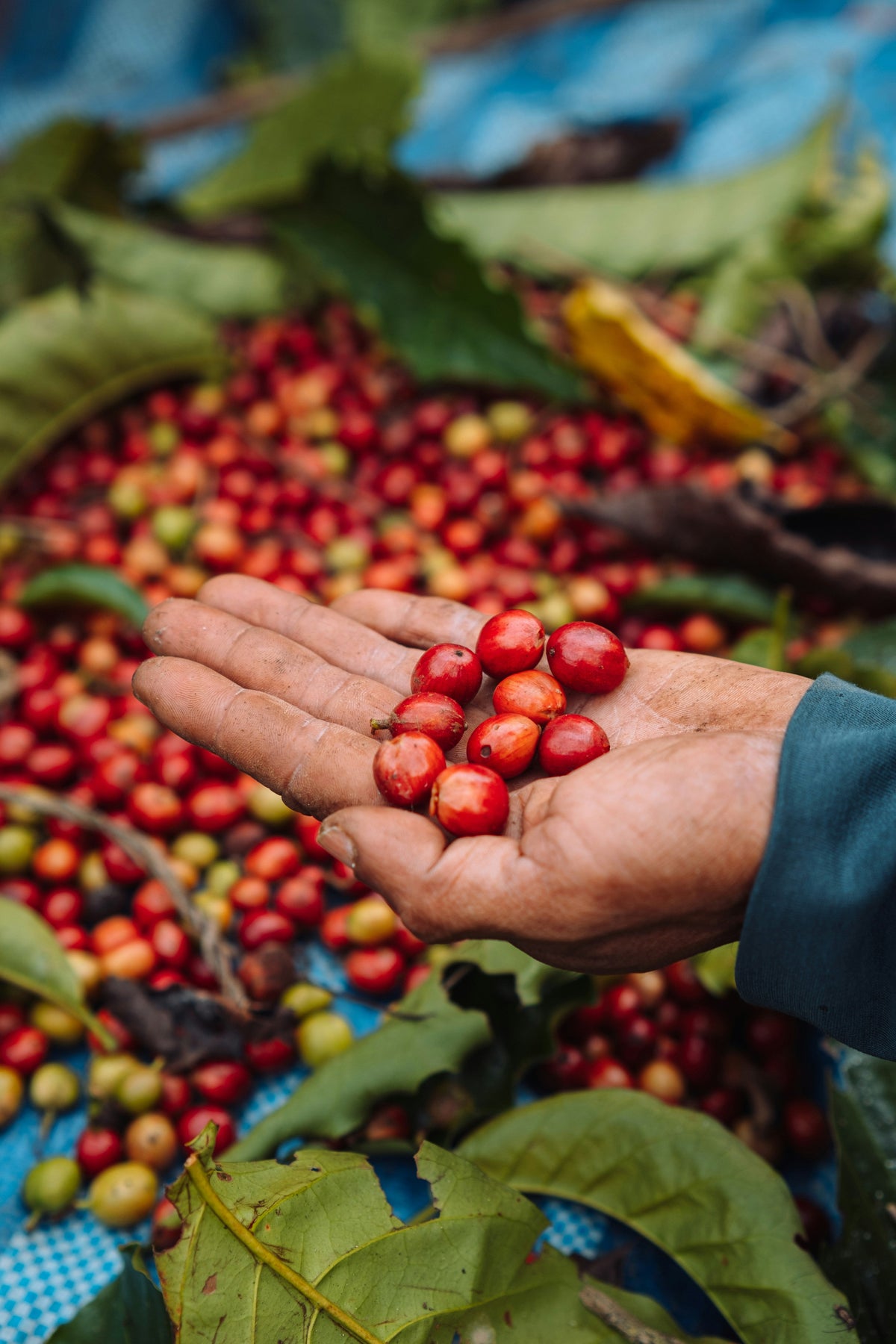
Think of an espresso at a bar counter in Italy. Thick crema, dark chocolate, a bitterness that holds its ground against a spoon of sugar. Now think of a filter coffee that tasted of peach, or jasmine, or something you could not quite name but wanted more of.
Those two cups probably came from two different plants. The first very likely had robusta in it. The second was probably arabica.

What is the difference between arabica and robusta?
Arabica and robusta are two separate species of the coffee plant. Arabica (Coffea arabica) grows in cool, high-altitude regions, has less caffeine and tends to taste sweeter, with more fruit and acidity. Robusta (Coffea canephora) grows in warmer, lower regions, has roughly twice the caffeine and tastes heavier, with more bitterness and body.
Neither one is good or bad by default. How a coffee tastes in your cup depends far more on how it was grown, picked, processed and roasted than on which species it is. Everyone has different taste, so in the end what matters is which coffee tastes right to you. Next time you drink a coffee you like, pay attention to whether it was arabica or robusta. This way the next time you buy some beans it's a little less guesswork 😉
Arabica vs robusta at a glance
| Arabica | Robusta (canephora) | |
|---|---|---|
| Botanical name | Coffea arabica | Coffea canephora |
| Where it grows | Cool highlands, roughly 1,000 to 2,200m | Warm lowlands, mostly below 800m, in places up to about 1,200m |
| Caffeine in the bean | About 1.2 to 1.5 % | About 2.2 to 2.7 % |
| Typical taste | Sweet, fruity, floral, lively acidity | Dark chocolate, nuts, malt, low acidity |
| Body | Lighter, silkier | Heavier, more syrupy |
| Crema in espresso | Thinner, finer | Thicker, longer lasting |
| Bean shape | Oval, curved centre line | Rounder, straight centre line |
| Yield and hardiness | Lower yield, sensitive to heat and pests | Higher yield, tolerates heat and pests |
| Share of world harvest | About 56 % (2026/27 forecast) | About 44 % (2026/27 forecast) |

Where do arabica and robusta grow?
Arabica is the mountain plant. It likes cool air, steady rainfall and altitude, which is why you find it on the slopes of Ethiopia, Colombia, Guatemala, among others. Up there the cherries ripen slowly, and that slow ripening gives the bean time to build sugars and the compounds we later taste as fruit and flowers. The trade-off: arabica is delicate. Too much heat, a pest or a fungus can cost a farmer a large part of the harvest.
Robusta lives further down, where it is hot and humid. Vietnam, Uganda, India, Brazil and Indonesia grow a lot of it. The name is fair: the plant is sturdy, shrugs off diseases that would flatten arabica, and carries more cherries per tree.
A detail we like: robusta is one of arabica's parents. Arabica came about long ago as a natural cross between canephora and another wild coffee species. So the two are closely related, however differently they turned out.

Which has more caffeine, arabica or robusta?
Robusta has about twice as much caffeine as arabica. For the plant, caffeine is a built-in insect repellent, which is part of why robusta copes so well in the lowlands where there are more pests.
For you, it means two things. A cup with robusta in it wakes you up a little harder. And because caffeine tastes bitter, it adds to that firm, bitter edge robusta is known for. The good type of bitter though.
How do arabica and robusta taste different?
Arabica beans hold clearly more sugar and close to twice the natural oils. In the cup that shows up as sweetness, a lighter and silkier feel, and a wide spread of flavours: berries, stone fruit, citrus, flowers, caramel. It also brings amazing acidity, like the brightness you know from biting into a ripe apple.
Robusta goes in the other direction. Less sugar, less acidity, more body. Picture dark chocolate, roasted hazelnuts, malt, sometimes a hint of spice or dried fruit, with a texture closer to syrup than to tea. In espresso it builds a thick, stable crema, which is why Italian espresso blends have relied on it for generations. It also holds its own in milk, where a delicate arabica can disappear.
Why is robusta used for mass-market coffee?
Robusta is easier and cheaper to grow in large quantities. It yields more per tree, needs less care, survives heat and disease, and grows on flat land where machines can do the picking. That makes it the natural choice for instant coffee, supermarket blends and anything that has to be produced in huge volumes at a low price.
This is also where its reputation comes from. For decades, robusta was grown for volume and nothing else: ripe and unripe cherries stripped together, dried fast, roasted very dark. The result tasted harsh, like burnt rubber or wet cardboard, and that taste got attached to the name.
Treat arabica the same way and it tastes rough too. What people learned to dislike was the careless handling, and robusta ended up taking the blame for it.
What do arabica and robusta mean in specialty coffee?
Specialty coffee is about how good and how traceable a coffee is, and species alone does not decide that. A coffee counts as specialty when it is grown with care, picked ripe, processed cleanly and scores high when trained tasters assess it.
The majority of specialty coffee is arabica, and there is a simple reason: its range of flavours is very wide, and roasters like us enjoy showing how different a coffee from Ethiopia can taste from one grown in Brazil. "100% arabica" on a bag, though, only tells you the species. It says nothing about whether the coffee inside was well grown or well roasted.
What is fine robusta?
Fine robusta is robusta grown and processed with the same attention that specialty arabica gets. Farmers pick only ripe cherries, sort them by hand, ferment and dry them with care. For years it had its own grading standard and its own licensed tasters. Since October 2025, the industry's main tasting licence covers arabica and canephora within one shared framework.
Producers in Uganda, India, Vietnam, Ecuador and Brazil are doing this work, and the cups are a long way from the old cliché. Clean, sweet, dense. Cocoa, toasted nuts, brown sugar, sometimes ripe fruit, with a body that coats your mouth and almost no sharpness.

There is a practical side as well. As growing regions get warmer, arabica is under pressure in many of the places it has always grown. A plant that handles heat well and can taste this good is one that farmers, and coffee drinkers, will be glad to have.
Why do people call robusta canephora?
Canephora is the botanical name of the species, Coffea canephora. Strictly speaking, robusta is only one group of plants within that species. Conilon, grown widely in Brazil, is another.
More and more roasters and producers now say canephora, pronounced ka-NEH-fo-ra. Partly because it is the accurate term. Partly because the word robusta carries decades of baggage, and a carefully grown coffee deserves to be tasted without it.
So if you see canephora on a bag or a menu, it is the species most people know as robusta, usually from someone who put real work into it.

Go by what you like to drink.
- You like fruity, floral, lively cups, often as filter: start with arabica. Pick the one that sounds best from our Filter collection.
- You like dark chocolate, a heavy body and low acidity: look for a fine robusta, or an espresso blend with some canephora in it. Our house blend Bandit is a great place to start.
- You drink mostly flat whites and cappuccinos: a share of canephora gives the coffee the weight to come through the milk.
- You want a stronger caffeine kick: robusta has about double.
- You add sugar to your black coffee: try arabica and skip the sugar.
And the next time you are at one of our cafés, ask what we brewed that day. We are always happy to talk you through it, or to put two cups next to each other so you can taste the difference yourself.
Frequently asked questions
Is arabica better than robusta?
Not by default. Arabica offers a wider range of flavours and more sweetness, which is why most specialty coffee is arabica. A carefully grown robusta can taste better than a carelessly grown arabica. Quality comes from farming, processing and roasting.
Is robusta stronger than arabica?
Yes, in two ways. Robusta contains roughly twice the caffeine, about 2.2 to 2.7 % compared with 1.2 to 1.5 % in arabica. It also tastes more intense, with more bitterness and a heavier body.
What is canephora coffee?
Canephora is the botanical name for the species commonly called robusta (Coffea canephora). Robusta is technically one group within that species. Many specialty roasters now use canephora because it is a more accurate term, and the name robusta has been linked to badly processed mass coffee production in the past.
Does 100% arabica mean the coffee is good?
No. It only names the species. There is excellent arabica and poor arabica. Origin, harvest, processing and roast tell you much more about what ends up in your cup.
Can robusta be specialty coffee?
Yes. Fine robusta is grown, picked and processed to specialty standards and assessed by licensed tasters, just like arabica. Expect cocoa, nuts, a syrupy body and very little acidity.
Why does robusta make more crema?
Robusta beans contain fewer oils than arabica, and oils break down foam. With less oil in the way, the crema on a robusta espresso turns out thicker and lasts longer.
Teilen:
Cold brew guide: Brewing at Home